AI Recruitment Software for Financial Services Firms: A 2026 Guide
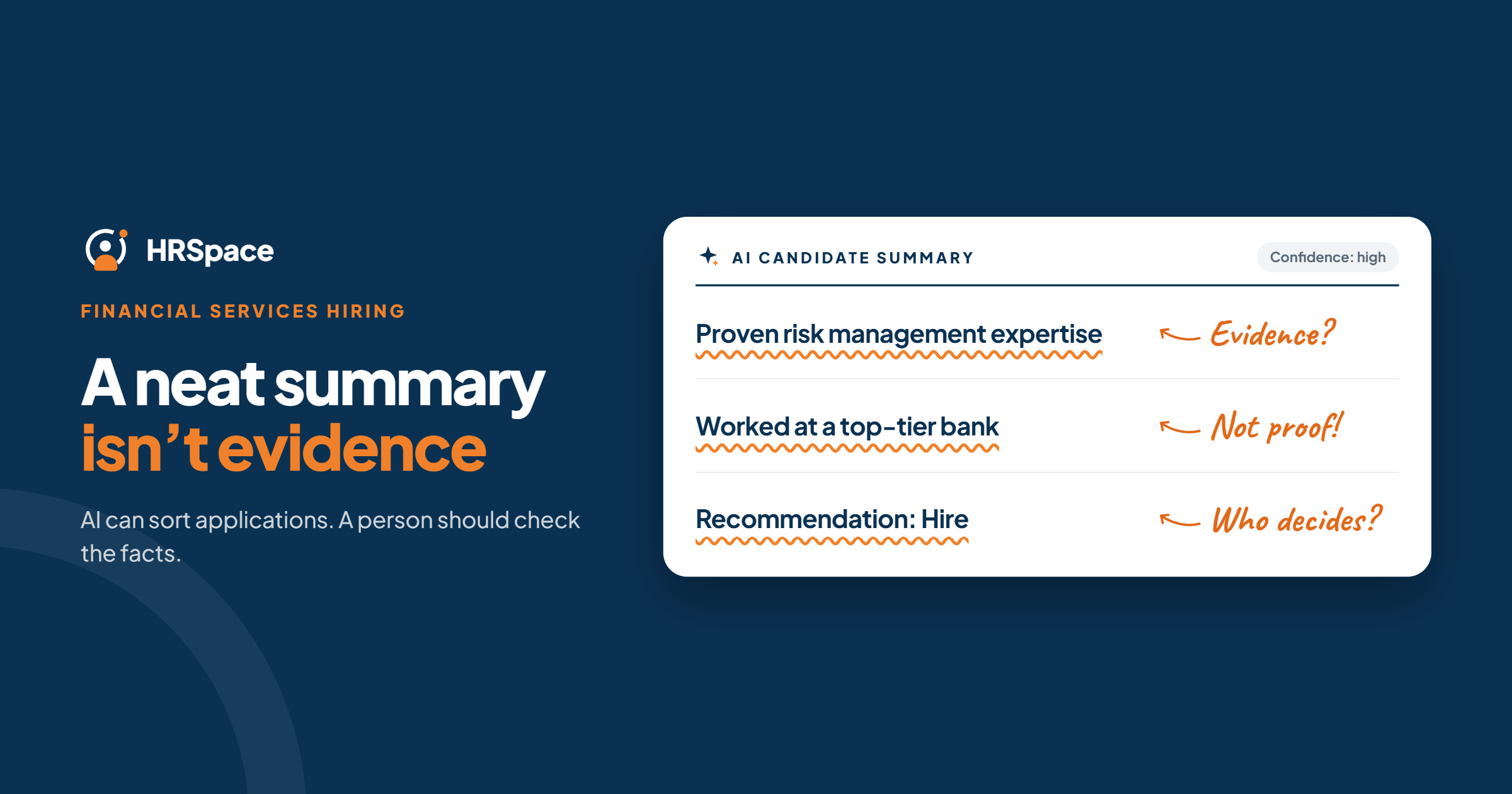
Financial services firms hire for judgment. A compliance analyst, a client adviser and an operations specialist each have to show different things, and some roles need verified credentials before anyone can start. AI can speed up parts of that process, but it can also make a confident-sounding summary look like evidence.
This guide covers what AI recruitment software actually does, why regulation matters in 2026, what to ask vendors, and where HRSpace fits. HRSpace includes an AI Recruitment module that links hiring to onboarding, so a hired candidate moves into the same workspace your team uses for the rest of HR.
What "AI recruitment" covers
The term bundles several different jobs:
- Sourcing: finding candidates in a database or on job boards.
- Screening: ranking or summarising applications.
- Interviewing: AI-led screening interviews or scored video assessments.
- Coordination: scheduling, reminders and candidate messages.
Tools lean towards one of these. Workable and Greenhouse are applicant tracking systems with AI layered in. HireVue is known for structured video interviews and assessments. Paradox focuses on conversational, high-volume hiring. Eightfold targets large-scale talent matching. Public pricing varies from a few hundred dollars a month to custom enterprise quotes.
Why regulation matters now
Using AI to screen or rank candidates is regulated in a growing number of places. A few examples, based on recent reporting (check current status with your legal adviser):
- New York City has required bias audits and candidate notice for automated employment decision tools since July 2023.
- Illinois amended its Human Rights Act to cover AI in employment decisions, effective 1 January 2026.
- The EU AI Act treats AI used in recruitment as high-risk. Recent reports say the main high-risk obligations were deferred to 2 December 2027, though some duties already apply. Many guides online still show the old date.
- Other US states have rules that are still changing.
You are responsible for how you use a tool, even when someone else built it. If you screen candidates in these places, or candidates who live there, ask vendors for documentation, not reassurance.
What's different about financial services
Credentials and checks matter, and AI doesn't verify them. Many roles need professional registrations, background checks or regulator approvals, and these differ by country and role. A summary stating that someone is licensed proves nothing. Keep verification with the approved process and a named person.
Roles are not interchangeable. An adviser, a compliance analyst and an operations specialist need different scorecards. Experience supporting a regulated team isn't the same as owning its responsibilities, and a summary can blur that.
The cost of a bad hire is high. That is a reason to keep decisions with accountable people, not to avoid assistance.
What to ask a vendor
- Does the AI score, rank or reject candidates, or only summarise?
- Can a reviewer see the original evidence and override the output?
- Is there a bias audit or equivalent documentation, and can you see it?
- How are candidates notified that AI is used?
- What happens to candidate data? Who can see it, how long is it kept, and is it used to train models?
- Which locations and languages does it support?
Where HRSpace fits
HRSpace's AI Recruitment module ($1 per employee per month) covers job posts, a candidate pipeline and AI-led screening interviews. Hired candidates flow straight into Onboarding ($0.50), where each new-hire task has an owner. Everything sits in the same workspace as time off, records, goals and reviews.
How HRSpace makes this easier
For a small financial services firm, hiring often slips between the manager, HR and compliance. Candidates are tracked in a spreadsheet, interview notes live in email, and nobody is sure who owns the pre-employment checks once an offer is accepted.
With HRSpace the pipeline, the screening and the handover to onboarding are in one place. A named person owns each step, and the unresolved items stay visible until they are done. You can keep the final decision with a human reviewer and treat AI screening output as one input.
Where it doesn't fit
HRSpace isn't a specialist for high-volume sourcing, and it doesn't verify credentials or run background checks. Use the appropriate specialist providers for those, and ask us for the documentation described above if you plan to use AI screening where bias-audit or disclosure rules apply.
Set up a hiring process you can explain
Write the scorecard first. For each role, list responsibilities and the evidence needed. Separate mandatory credentials from preferred experience, and use observable questions, such as asking an operations candidate how they would investigate a reconciliation discrepancy.
Put names on decisions. Someone sets the criteria, someone reviews the evidence, someone communicates with the candidate, and someone makes the decision. A software setting isn't an accountable person.
Limit candidate data. Collect what you need for a defined purpose, restrict access and keep interview notes about job-related evidence.
Plan the handoff. Decide who owns the accepted offer, the start date, onboarding tasks and any outstanding checks.
Test what happens when the AI is wrong
Before you commit, test an application with conflicting evidence, such as an impressive summary that doesn't match the CV, or a non-standard career path. Check whether a reviewer can find the source, correct the record and document the decision. The correction path matters as much as the first recommendation.
What it costs
For a 50-person firm:
- Base layer (records, documents, time off, timesheets): $50/month
- AI Recruitment: $50/month
- Onboarding: $25/month
- Total: $125/month, billed monthly with no setup fee
A 14-day free trial needs no credit card.
Frequently asked questions
Can AI make the final hiring decision?
Keep the decision with an accountable person. Use AI output as one input and make sure reviewers can see the underlying evidence and override it.
Is AI recruitment software regulated?
In many places, yes. New York City, Illinois and the EU, among others, have rules or upcoming rules covering AI in hiring. Check current requirements where you recruit.
Does AI verify financial-services credentials?
No. Credential and background checks should follow your approved process.
Does HRSpace verify credentials or run background checks?
No. Use specialist providers for those.
How should we test AI recruiting software?
Compare it with manual review using the same written scorecard, include incomplete and unusual applications, and record omissions and unsupported claims.
Can I try HRSpace before buying?
Yes, with a 14-day free trial and no credit card.
Where to go from here
To see how recruiting hands off to onboarding, start a free 14-day HRSpace trial or read about AI Recruitment. If you're comparing recruiting systems, see our HRSpace vs Eploy guide.
Ready to make HR the easy part?
Explore modular pricing and start a free 14-day trial.